
Study 05 / Mix Chemistry & Mass Concrete
Two Thousand Miles of River-Water Cooling Pipe and Marcel Breuer's Folded Concrete at Grand Coulee
Preventing twelve million cubic yards of Columbia River mass concrete from cracking under hydration heat took Type IV low-heat cement and two thousand miles of embedded river-water pipe prior to Marcel Breuer's 1967 folded concrete Third Powerplant.
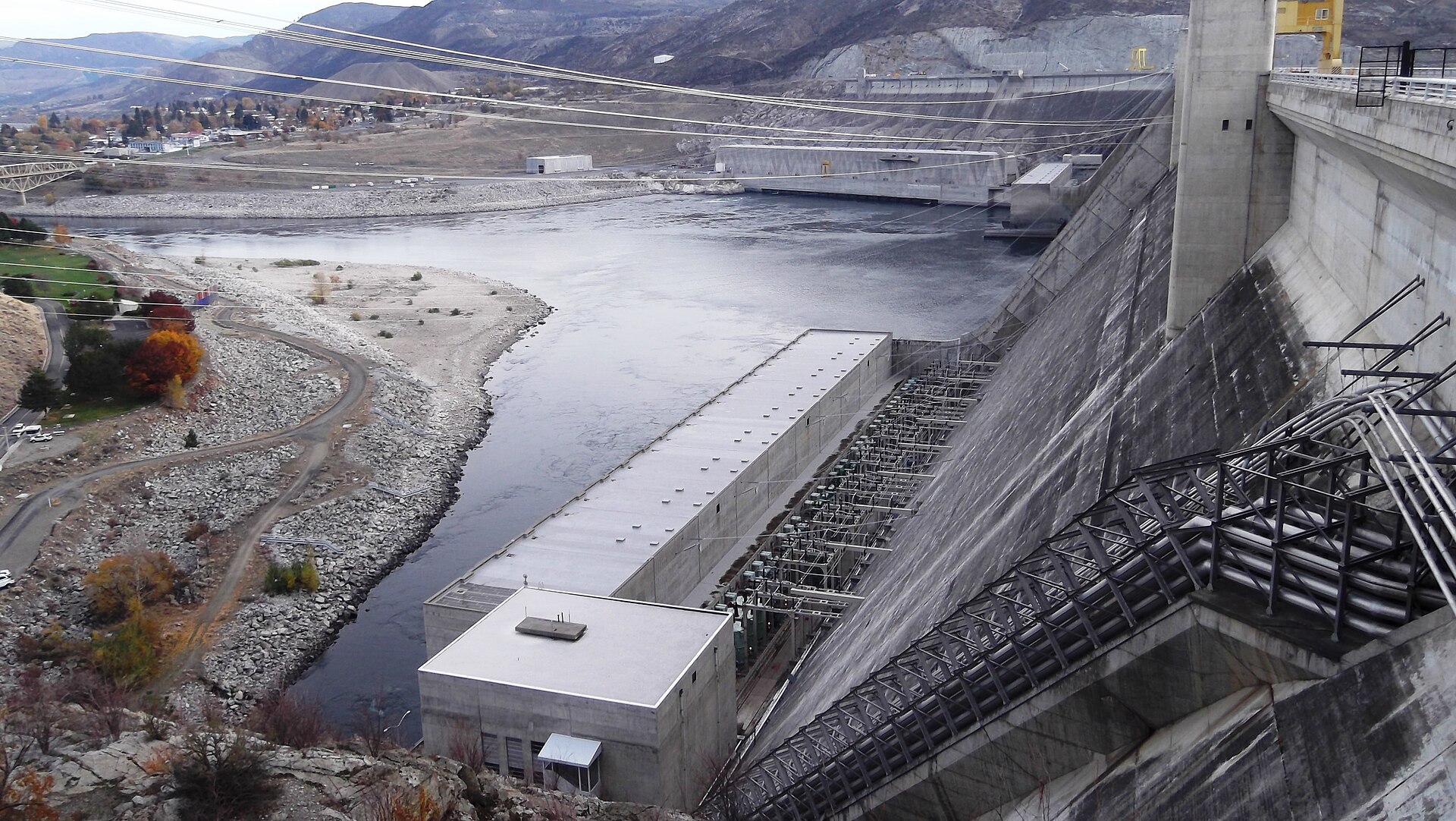
Ninety miles west of Spokane above Washington State Route 155, twelve million cubic yards of mass concrete rise 550 feet out of the Columbia River granite canyon across a 5,223-foot crest built between July 16, 1933 and 1975. At the United States Bureau of Reclamation, chief designing engineer John Lucian Savage laid out the 1933 gravity dam so Columbia River generators could power wartime aluminum potlines together with shipyards downriver in Vancouver, Washington as well as Portland, Oregon.
When I drive northeast out of Portland with a four-by-five view camera after eight years finishing commercial slabs in Oregon, that sharp kink where the 1967 forebay meets the 1942 abutment catches hard afternoon light. How did Bureau of Reclamation crews pull hydration heat out of five-foot concrete lifts in the 1930s, and why did Marcel Breuer dynamite open the northeast wing in July 1967?
Mason-Walsh-Atkinson-Kier and 2,000 Miles of Columbia River Cooling Pipe
On July 13, 1934, Mason-Walsh-Atkinson-Kier won the Columbia River cofferdam and foundation contract prior to Consolidated Builders Incorporated of Oakland taking over upper monolith pours on May 12, 1938. Daily placement topped twenty thousand cubic yards inside fifty-foot-square interlocking concrete columns. Without internal cooling, Portland cement hydration heat inside those blocks would have lingered for decades and cracked the dam.
Reclamation concrete engineers specified Type IV low-heat Portland cement formulated with lowered tricalcium aluminate alongside reduced tricalcium silicate so each lift cured cooler. Crews laid two thousand miles of thin-walled one-inch steel pipe across the top of every five-foot concrete lift and pumped cold Columbia River water through the coils until block cores dropped to forty-five degrees Fahrenheit before grouting the contraction joints shut.
Marcel Breuer and Hamilton Smith's 1967 Folded Concrete Third Powerplant
After Canada and the United States ratified the Columbia River Treaty in 1964, the Bureau of Reclamation hired Marcel Breuer together with partner Hamilton Smith at Marcel Breuer and Associates to design the Third Powerplant, now the Nathaniel Washington Power Plant. In July 1967, blasting crews took 260 feet off the 1942 northeast gravity wing so builders could key in a 1,170-foot angled concrete forebay dam.
Inside and outside that 2,000-foot turbine hall completed in 1975, Breuer and Smith cast board-formed folded concrete V-columns alongside cantilevered observation decks below six forty-foot-diameter steel penstocks on the granite bank. Ninety-three years after first excavation on July 16, 1933 above State Route 155, John Lucian Savage's pipe-cooled monoliths and Marcel Breuer's folded board-marked concrete stand locked into the same Columbia River wall.
Soren Lindqvist (Portland, Oregon, Architectural Photographer). I spent eight years finishing commercial slabs and terrazzo floors in Oregon prior to photographing cast-in-place and brutalist buildings across the Pacific Northwest.
Text by Soren Lindqvist is published under Creative Commons Attribution 4.0 International (CC BY 4.0). Photographs carry the licenses credited in their captions.